

Engineering
Request a Job Quote
Submit a Quote Form and a Southway Sales Representative will be in contact with you as soon as possible.
GET A QUOTECrane Lift Planning & Engineering Services for Complex Projects
At Southway Crane & Rigging, we provide comprehensive lift planning and engineering services for commercial construction, industrial facilities, infrastructure projects, manufacturing plants, utility contractors, and energy producers throughout the United States. Our in-house engineering team works closely with project managers, crane operators, contractors, and rigging crews to develop practical lifting solutions supported by detailed engineering documentation.
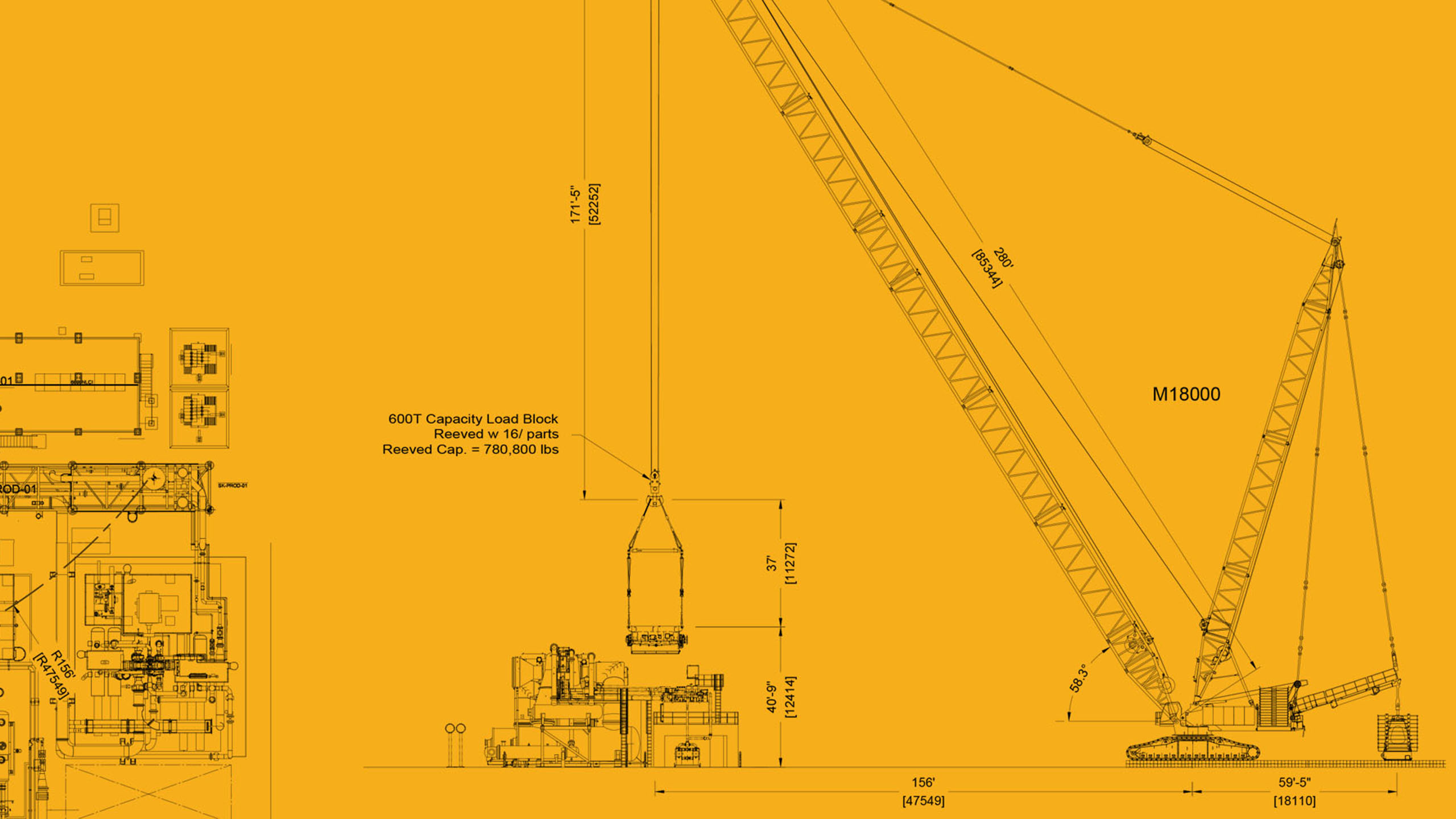
Using professional software including AutoCAD, Revit, Lift Planner, Work Planner, and 3D Lift Plan, we prepare lift plans, rigging drawings, crane layouts, and supporting calculations tailored to the specific requirements of each project. Professional Engineer (P.E.) review and stamped drawings are available whenever required by project specifications or regulatory authorities.

Typical Engineering Applications
Engineering support is commonly provided for:
- + Structural steel erection
- + Bridge and highway construction
- + Petrochemical and refinery maintenance
- + Manufacturing plant expansions
- + Data centre construction
- + Wind and renewable energy projects
- + Power generation facilities
- + Water and wastewater treatment plants
- + Heavy equipment installations
- + Industrial shutdowns
- + Modular construction projects
- + Multi-crane lifting operations
Rather than relying on generic templates, every engineering package reflects the actual equipment, site conditions, and operational requirements associated with the project.
Engineering Services We Provide
Crane Selection & Lift Configuration
Selecting the right crane requires much more than comparing the crane's capacity with the weight of the load.
Our engineers evaluate boom configuration, working radius, lift height, counterweight requirements, setup space, access routes, and anticipated ground conditions before recommending equipment for the project.
Careful equipment selection improves efficiency while helping avoid unnecessary mobilization costs or equipment changes later in the schedule.
Critical Lift Planning
Some lifting operations require additional planning because of restricted work areas, complex rigging arrangements, multiple cranes, sensitive equipment, or the potential consequences of an unexpected incident.
Critical lift plans document every stage of the operation, including crane positioning, rigging methods, lift sequencing, communication procedures, operating limitations, and contingency planning. This allows everyone involved to clearly understand the lifting procedure before work begins.
Rigging Drawings
Proper rigging plays a significant role in maintaining load stability throughout a lift.
Our engineering team prepares detailed rigging drawings showing lifting points, center of gravity, sling configurations, spreader beams, lifting beams, shackles, hooks, and below-the-hook lifting devices. These drawings improve communication between engineers, supervisors, operators, and rigging crews while supporting safe project execution.
Ground Bearing Pressure Analysis
Safe crane operation depends on stable ground conditions.
Ground bearing pressure analysis determines how much force crane outriggers or crawler tracks apply to the supporting surface. Our engineers review soil conditions, anticipated loading, and crane configuration to determine whether crane mats or other load distribution methods should be incorporated into the lift plan.
These evaluations are particularly valuable on recently disturbed ground, industrial facilities, bridge approaches, utility corridors, and construction sites where soil conditions may vary.
Wind Studies
Wind conditions affect every crane differently depending on the equipment configuration and the characteristics of the load being handled.
Large structural components, pressure vessels, mechanical equipment, and prefabricated modules can all respond differently to changing wind conditions. Our engineering team reviews manufacturer operating limitations together with project-specific conditions to establish safe operating parameters before lifting begins.
Site Layouts & Supporting Documentation
Well-prepared documentation helps keep projects organized from planning through execution.
Engineering packages may include crane setup drawings, equipment layouts, outrigger locations, lift paths, exclusion zones, access routes, utility clearances, and placement locations. Supporting documentation can also include crane load charts, rigging certifications, inspection reports, equipment specifications, and other project-specific information needed to support field operations.
Why Choose Our Engineering Services?
Customers also benefit from having engineering, crane rental, specialized rigging, heavy haul transportation, machinery moving, and industrial storage coordinated through one experienced provider. Managing these services under a single team simplifies scheduling and helps projects move more efficiently from planning through completion.
Our Engineering Process
Step 1: Initial Consultation
We begin by reviewing available drawings, project specifications, equipment information, load weights, schedules, and customer objectives to establish the scope of work.
Step 2: Site Assessment
When required, our engineering team visits the project site to verify measurements, evaluate crane access, identify overhead restrictions, review ground conditions, and confirm lifting requirements before engineering begins.
Step 3: Engineering Development
Using the collected information, our engineers prepare lift plans, engineering calculations, rigging drawings, crane layouts, ground bearing analyses, and supporting documentation tailored to the project.
Step 4: Plan Review
Before equipment is mobilized, engineering documents are reviewed with project stakeholders. If site conditions or equipment requirements change, documentation can be revised to reflect updated project information.
Step 5: Project Support
During project execution, our crane operators and rigging crews perform the work using the approved engineering package, while additional engineering assistance remains available whenever technical support is required.
Frequently Asked Questions
When is a critical lift plan required?
A critical lift plan is required when a lift exceeds 75 percent of the crane’s rated capacity, involves multiple cranes, requires hoisting personnel, places loads outside the operator’s view, or uses non-routine rigging configurations. Southway Crane & Rigging provides comprehensive critical lift planning with professional engineer review and stamp available upon request.
How far in advance should lift plans be submitted?
Standard lift plans should be submitted at least 48 hours prior to crane mobilization, while critical lift plans require five business days advance notice. This timeline allows for thorough review, professional engineer evaluation when needed, and coordination with all stakeholders before crews arrive on site.
What is ground bearing pressure analysis?
Ground bearing pressure analysis calculates the force exerted by crane outriggers or tracks onto the supporting surface to ensure the soil can safely support the equipment and load without failure. We evaluate soil bearing capacity, determine required crane mat sizes, and verify that ground conditions can withstand concentrated loads that can exceed 10,000 pounds per square foot for larger cranes.
How is maximum allowable wind speed determined?
Maximum allowable wind speed is determined by crane manufacturer specifications, load characteristics, boom configuration, and site conditions evaluated by a competent person. Southway Crane & Riggin provides site-specific wind speed studies that consider equipment limits, load surface area, and real-time weather monitoring requirements to establish safe operational parameters.
What information do I need to provide for a lift plan?
You need to provide accurate load weight with supporting documentation, load dimensions and center of gravity, pick and set locations, site conditions including soil type and utilities, required lift radius and height, and rigging attachment points. Information about overhead hazards, access routes, and project schedule also helps us develop comprehensive plans tailored to your operation.
How long does it take to complete a lift plan?
Standard lift plans typically require two to three business days once all project information is received, while critical lift plans may take five to seven business days depending on complexity. Providing complete information upfront helps expedite the process while ensuring thorough safety analysis and coordination.
What is included in a site walk verification?
Site walk verification includes physical inspection of crane setup locations, measurement verification of clearances and obstructions, validation of access routes, identification of overhead hazards and underground utilities, and confirmation of adequate space for operations. We document actual site conditions and identify any discrepancies from design documents before mobilization.
What is the difference between standard and critical lifts?
Standard lifts operate below 75 percent of crane capacity, use routine rigging, and maintain loads within the operator’s view. Critical lifts exceed 75 percent capacity, require multiple cranes, involve complex rigging, or present significant consequences if issues occur, requiring detailed written procedures, additional safety precautions, and often professional engineer review.